
Hague Apostille Convention: What Canadians Need to Know
Hague Apostille Convention: What Canadians Need to Know ! Woman reviewing Canadian apostille documents at desk Canada is a Contracting Party to the Hague Apostille Convention.

Hague Apostille Convention: What Canadians Need to Know
Canada is a Contracting Party to the Hague Apostille Convention. The Convention took effect in Canada on January 11, 2024, as confirmed by Global Affairs Canada. Since that date, eligible Canadian public documents no longer require the traditional consular legalization chain for use in member countries. An apostille replaces that process with a single certificate issued by the appropriate Competent Authority.
The immediate next steps are straightforward:
- Confirm the destination country is a Hague member by checking the HCCH status table.
- Identify the correct Competent Authority: Global Affairs Canada (GAC) for federally issued documents, or the designated provincial/territorial office for documents issued at the provincial level.
- Prepare an original or certified copy of the eligible public document.
- Submit to the correct authority with the required fee.
Speedyapostilleservices can assist with document review, submission, and secure handling for individuals and organizations across Canada.
Table of Contents
- What the Hague Apostille Convention does for Canadians
- How to check whether your destination country accepts apostilles
- Which Canadian documents are eligible for an apostille
- Who issues apostilles in Canada: GAC or provincial authorities?
- Step-by-step: how to get an apostille for a Canadian document
- Fees, processing times, and service options in Canada
- Special cases and common pitfalls to watch for
- What to do if the destination country is not a Hague party
- Key Takeaways
- When using a professional service makes sense
- Speedyapostilleservices: transparent pricing, fast turnaround
- Official sources and additional reading
- FAQ
What the Hague Apostille Convention does for Canadians
An apostille is a standardized certificate that authenticates the origin of a public document. It confirms the signature, seal, and capacity of the official who signed the document. It does not validate the document's substantive content, such as whether the facts stated in a birth certificate are accurate. That distinction matters: recipients expecting content verification will not get it from an apostille alone.

Before Canada's accession, Canadians sending public documents abroad had to go through a multi-step legalization chain involving authentication by Canadian authorities and then legalization at the destination country's embassy or consulate. The Apostille Convention replaced that process with a single certificate, reducing cost and processing time for documents going to member countries.
The Convention now has 130 Contracting Parties, making it one of the most widely adopted international legal instruments in the world. That reach means an apostilled Canadian document is accepted in most major destination countries without any additional authentication steps.
How to check whether your destination country accepts apostilles
The authoritative source is the HCCH Contracting Parties status table. The table lists every member country and the date the Convention entered into force for that state. Both dates matter: the country must have been a member, and the Convention must have been in force between Canada and that country, at the time the document is being used.
Some countries have signed or acceded to the Convention but the Convention is not yet in force between them and Canada. In those cases, an apostille may not be accepted. Always check the effective date column, not just whether the country appears on the list.
Even when a country is a confirmed member, the receiving organization may have its own requirements. A university, employer, or government office abroad may require a specific format, a certified translation, or additional attestation beyond the apostille itself.
Pro Tip: Contact the receiving organization directly before submitting your documents. Confirm whether they accept apostilles, whether they require a translation, and whether they have any formatting rules. This step prevents rejections that have nothing to do with the apostille itself.
Which Canadian documents are eligible for an apostille
The general rule is that public documents issued by a government authority, court, or public official are eligible. Private documents are not eligible unless they have been notarized by a public notary, which makes them a public document for this purpose.
Common eligible document categories:
- Vital records: birth certificates, marriage certificates, death certificates issued by provincial vital statistics offices
- Judicial documents: court orders, judgments, divorce decrees issued by provincial or federal courts
- Administrative certificates: certificates of status, letters of good standing, government-issued identity documents
- Educational documents: diplomas, transcripts, and degrees issued by accredited institutions (typically require notarization first)
- Corporate documents: certificates of incorporation, articles of amendment, corporate good standing letters from provincial registries
- Police and background checks: RCMP criminal record checks and local police certificates
Originals are generally required. A certified copy is acceptable when the issuing authority has produced it and it bears the original seal and signature of the issuing office. U.S. Department of State guidance on document preparation stresses that seals and signatures must be original and visible on the submitted copy.
Do not add extra notarial seals to original vital records that already bear the issuing authority's seal. Adding a notary stamp to an original that already carries the government seal can render the document invalid for authentication purposes.
Who issues apostilles in Canada: GAC or provincial authorities?
The issuing authority depends on where the document originated, not where you live.
| Document type | Issuing authority | Competent Authority for apostille |
|---|---|---|
| Federal government letters, federal court orders | Federal body | Global Affairs Canada (GAC) |
| Passports (note: passports are generally not apostilled) | Federal | Global Affairs Canada (GAC) |
| Birth, marriage, death certificates | Provincial vital statistics office | Provincial/territorial designated authority |
| Provincial court orders and judgments | Provincial court | Provincial/territorial designated authority |
| Provincial corporate registry documents | Provincial registry | Provincial/territorial designated authority |
| RCMP criminal record checks | Federal (RCMP) | Global Affairs Canada (GAC) |
| University diplomas and transcripts (notarized) | Educational institution (notarized) | Provincial/territorial designated authority |
The rule of thumb: look at the seal on the document. The issuing authority printed on the document determines which Competent Authority handles the apostille. Ontario's Official Documents Services (ODS) is one example of a provincially designated office. Other provinces have their own designated units. For Quebec-specific procedures, the apostille process in Quebec follows a distinct set of provincial steps.
When in doubt, contact the Competent Authority before submitting. Sending a provincial document to GAC, or vice versa, will result in rejection and delay.
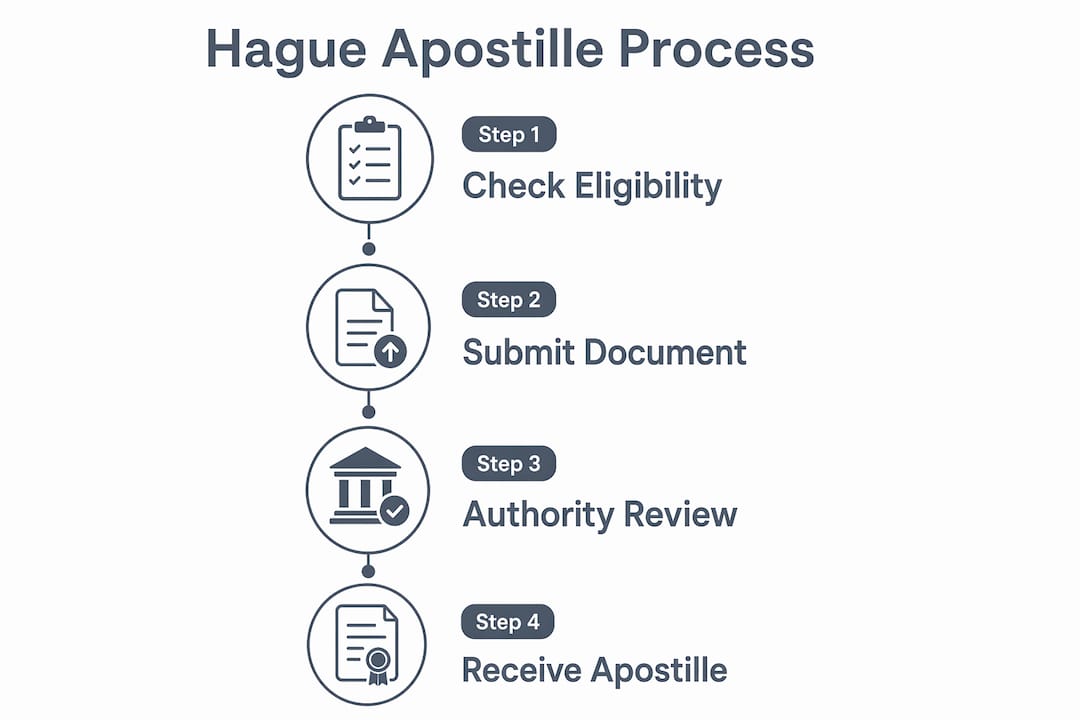
Step-by-step: how to get an apostille for a Canadian document
-
Confirm eligibility. Verify the document is a public document and the destination country is a Hague member. Check the HCCH status table for the effective date.
-
Identify the correct Competent Authority. Use the issuing authority on the document to determine whether to submit to Global Affairs Canada or the relevant provincial/territorial office.
-
Obtain an original or certified copy. Request a certified copy directly from the issuing office if you do not have the original. Seals and signatures must be original and legible.
-
Notarize only when required. Notarization is needed for private documents (diplomas, affidavits) to make them eligible. Do not add a notary seal to original government-issued vital records that already carry an official seal.
-
Arrange translations if required. If the destination country or receiving organization requires a translation, use a certified professional translator and follow any attestation steps the receiving authority specifies.
-
Complete any required application forms. Check the Competent Authority's website for current forms, cover letter requirements, and submission instructions.
-
Assemble fees and identification. Government fees vary by authority. Include a prepaid return envelope or courier label if submitting by mail.
-
Submit by mail or in person. Follow the specific submission instructions for the Competent Authority. Keep copies of everything you send.
-
Verify after issuance. Contact the issuing Competent Authority to confirm authenticity if needed. Where supported, the Electronic Apostille Programme (e-APP) allows electronic verification of issued apostilles.
Pro Tip: Request a document review before submission. A trusted provider or the Competent Authority itself can identify missing seals, incorrect copies, or unnecessary notarizations that would otherwise cause rejection.
For a full step-by-step apostille guide covering all Canadian provinces, Speedyapostilleservices publishes detailed instructions on its site.
Fees, processing times, and service options in Canada
Government fees for apostilles vary by province and by the type of document. Fees are charged per document and are set by each Competent Authority. They are not uniform across Canada.

| Service type | Typical processing time |
|---|---|
| Standard government processing | Several weeks (varies by authority and volume) |
| Expedited government processing (where available) | Varies; not all authorities offer this |
| Private expedited service (e.g., Speedyapostilleservices) | 1–7 business days; typical turnaround 2–3 days |
Private services like Speedyapostilleservices use all-inclusive pricing that bundles government fees with the service fee. That structure eliminates the need to calculate fees separately and reduces the risk of underpayment.
Allow additional time before submission for obtaining certified copies from vital statistics offices or courts, for certified translations, and for return shipping. Postal delays are a common source of unexpected timeline extensions. For readers in the GTA, same-day apostille handling in Toronto is available through Speedyapostilleservices.
Special cases and common pitfalls to watch for
Common rejection causes:
- Adding a notary seal to an original vital record that already carries the government seal, which can invalidate the document
- Missing or illegible original seal or signature on the submitted document
- Submitting an uncertified photocopy where an original or certified copy is required
- Sending the document to the wrong Competent Authority (federal vs. provincial)
- Submitting a document issued by a body that is not a public authority
Special scenarios:
- Apostilling translations: the apostille goes on the original document, not the translation. If the receiving country requires an apostilled translation, the translation must be notarized first, then apostilled separately as a notarized document.
- Corporate documents: certificates of incorporation and good standing letters from provincial registries are eligible. Confirm the specific registry's process, as procedures vary by province.
- RCMP criminal record checks: these are federal documents and go to Global Affairs Canada for apostille. Processing times can be longer due to volume.
- Affidavits for citizenship applications: notarized affidavits are eligible public documents once notarized. For guidance on how affidavits function in citizenship documentation, specialist resources cover the specific attestation requirements.
- Lost or damaged apostilles: contact the Competent Authority that issued the original apostille. Re-issuance procedures vary by authority; some require a new application and fee.
Before submitting, check: legibility of all text and seals, presence of the issuing authority's original signature, correct document type for the receiving country's requirements, and that no unnecessary marks or stamps have been added.
What to do if the destination country is not a Hague party
If the destination country is not a Contracting Party to the 1961 Apostille Convention, an apostille will not be accepted. The traditional consular legalization process applies instead.
The general steps for consular legalization are: authentication by the relevant Canadian authority (typically Global Affairs Canada or a provincial authority), followed by legalization at the destination country's embassy or consulate in Canada. Some countries require multiple steps or intermediary certifications. The exact chain depends on the destination country's requirements.
Contact the destination country's embassy or consulate in Canada early in the process. Ask for the complete legalization chain, any translation requirements, and current processing times. Requirements change, and relying on outdated information is a common source of delay.
For long legalization chains or tight timelines, using a professional service reduces the risk of errors and missed steps. Speedyapostilleservices handles both apostille and traditional authentication requests for Canadian documents.
Key Takeaways
Canada joined the Hague Apostille Convention on January 11, 2024, replacing consular legalization with a single apostille certificate for eligible public documents sent to Contracting Parties.
| Point | Details |
|---|---|
| Canada's accession date | The Convention took effect in Canada on January 11, 2024; apostilles replace consular legalization for member countries. |
| Correct Competent Authority | Use Global Affairs Canada for federal documents; use the provincial/territorial authority for documents issued at the provincial level. |
| Eligible documents | Public documents with original seals and signatures qualify; do not add unnecessary notarizations to originals. |
| Verify destination membership | Always confirm the destination country is a Hague member via the HCCH status table before submitting. |
| Speedyapostilleservices | Offers document review, secure handling, and 1–7 day turnaround with all-inclusive pricing for Canadian apostille requests. |
When using a professional service makes sense
Most people can handle a single, straightforward apostille on their own. A birth certificate or marriage certificate with a clear issuing authority, a confirmed Hague destination, and no translation requirement is a manageable DIY process if there is enough lead time.
The calculation changes when the stakes are higher. Multiple documents, tight deadlines, unfamiliar provincial procedures, or documents that require both notarization and apostille are situations where errors are more likely and more costly. A rejected submission adds weeks to the timeline.
Speedyapostilleservices specializes in Canadian apostilles. The typical turnaround is 2–3 days. Pricing is all-inclusive, meaning government fees are bundled into the quoted price. The service covers document review before submission, which catches the most common rejection triggers before they become a problem. Over 1,000 reviews reflect consistent results across a range of document types and destinations.
Speedyapostilleservices: transparent pricing, fast turnaround
Speedyapostilleservices is a Toronto-based apostille expeditor for Canadian documents. The service covers birth certificates, marriage licenses, diplomas, transcripts, court documents, corporate records, and RCMP background checks for use in over 120 Hague Convention countries.

All-inclusive pricing means the government fee is included in the quoted amount. There are no separate charges added at the end. Turnaround options run from standard to rush, with most orders completed in 1–7 business days and a typical completion time of 2–3 days. Every submission includes a document review and secure handling.
To get started or review service options, visit Speedyapostilleservices for current pricing and submission details.
Official sources and additional reading
Use these sources directly for membership verification, submission addresses, and authoritative procedural guidance. Do not rely on unverified third-party pages for legal acceptance rules.
- Apostille Convention (HCCH): primary source for Convention text, purpose, and e-APP information.
- HCCH Contracting Parties status table: use this to verify destination country membership and effective dates.
- Global Affairs Canada: Authenticate a document for use outside Canada: Canada's official procedural guidance, including submission addresses and fee information for GAC.
- Canada.ca: Canada joins Apostille Convention: official government announcement confirming Canada's accession.
- U.S. Department of State: Apostille requirements: practical document preparation guidance applicable to North American documents.
- Provincial competent authority pages: each province publishes its own submission instructions. Search the province name plus "apostille" or "Official Documents Services" to locate the current contact page.
- HCCH Explanatory Report on the 1961 Apostille Convention: authoritative explanation of what an apostille certifies and its legal limits.
FAQ
Is Canada part of the Hague Apostille Convention?
Yes. Canada formally acceded to the Hague Apostille Convention, and the Convention took effect in Canada on January 11, 2024, as confirmed by Global Affairs Canada.
How do I get a document apostilled in Canada?
Submit the eligible public document to the correct Competent Authority: Global Affairs Canada for federally issued documents, or the designated provincial/territorial authority for documents issued at the provincial level. The full process requires an original or certified copy with visible seals and signatures.
How long does it take to get an apostille in Canada?
Standard government processing takes several weeks, depending on the authority and current volume. Private expedited services such as Speedyapostilleservices typically complete requests in 1–7 business days, with a standard turnaround of 2–3 days.
How much does an apostille cost in Canada?
Government fees vary by province and document type and are set by each Competent Authority. Private services use per-document pricing; Speedyapostilleservices uses all-inclusive pricing that bundles government fees into the quoted amount, with no separate charges added later.
What if my destination country is not a Hague member?
If the destination country is not a Contracting Party, an apostille will not be accepted. The traditional consular legalization process applies: authentication by a Canadian authority followed by legalization at the destination country's embassy or consulate in Canada.