
Apostille Quebec: Complete 2026 Process Guide
Apostille Quebec: Complete 2026 Process Guide ! Woman reviewing Quebec apostille documents An apostille in Quebec is an official certificate issued by the Quebec Ministry of Justice that authenticates a document's signature or seal for use in countries that belong to the Hague Apostille Convention

Apostille Quebec: Complete 2026 Process Guide
An apostille in Quebec is an official certificate issued by the Quebec Ministry of Justice that authenticates a document's signature or seal for use in countries that belong to the Hague Apostille Convention. Quebec became a designated competent authority under the Convention on january 11, 2024, which replaced the older consular legalization chain for member countries. This guide covers which documents qualify, how to submit your request correctly, translation requirements, and the most common mistakes that cause delays.
What documents qualify for apostille in Quebec?
The Quebec Ministry of Justice issues apostilles for documents that originate from Quebec provincial authorities. The document must be an original or a certified true copy issued by a recognized Quebec authority. Federal documents, such as passports or documents issued by Global Affairs Canada, fall outside Quebec's jurisdiction entirely.
Documents that qualify for a Quebec apostille include:
- Birth, marriage, and death certificates issued by the Directeur de l'état civil
- Academic diplomas and transcripts issued by Quebec universities and colleges
- Court judgments and legal rulings from Quebec courts
- Corporate records such as certificates of incorporation from the Quebec business registry
- Notarial acts prepared by a Quebec notary
Notarial acts require one extra step before you apply. Notaries must authenticate their own acts per provincial standards before you submit to the Ministry of Justice. Skipping this step causes immediate rejection. No exceptions apply.
The provincial versus federal distinction is the single most misunderstood part of the process. Sending a federal document to the Quebec Ministry of Justice, or sending a Quebec document to Global Affairs Canada, results in rejection. Always confirm which authority issued your document before you apply.

How to submit your apostille request in Quebec
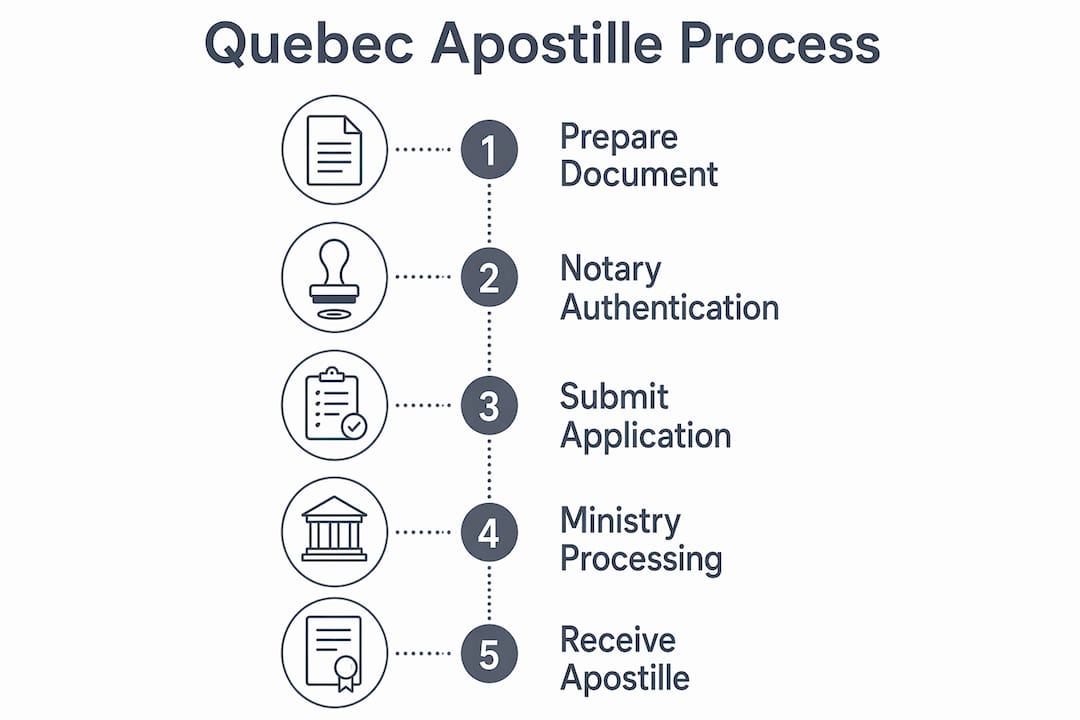
The Quebec Ministry of Justice accepts apostille requests by mail only. There is no in-person or online submission option. Follow these steps to prepare and send your application correctly.
- Download the official apostille request form from the Quebec government website. Use only the current version. Outdated forms are rejected without review.
- Complete the form fully. Include the document type, the issuing authority, and the destination country. Do not leave any field blank.
- Do not staple the form to your document. The official requirement states that the form must not be attached to the document. Bundle them separately in the same envelope.
- Prepare your payment. The fee is $66.50 CAD per document. Accepted payment methods are credit card, money order, and bank draft. Personal checks are not accepted.
- Use a sturdy mailing envelope. Documents must arrive undamaged. Bent or torn documents can be rejected.
- Mail your package to the Montreal office: 276, rue Saint-Jacques, bureau 301, Montréal, QC H2Y 1N3.
- Track your mailing. Use registered or tracked mail so you have proof of delivery.
Processing takes approximately four days once the Ministry receives your package. Add mailing time on both ends when planning your timeline.
Pro Tip: The apostille application expires if the Ministry does not receive it within three months of the form date. If your application is cancelled, you must start over and pay again. Mail your package promptly after completing the form.
Do you need a certified translation with your Quebec apostille?
An apostille authenticates only the signature or seal on a document. It does not translate or validate the document's content. This distinction matters for international use.
Quebec documents are typically in French. Many destination countries require a certified translation before they accept a document, regardless of whether it carries an apostille. Certified translation by OTTIAQ members is the recognized standard for Quebec documents destined for non-French-speaking countries. OTTIAQ is the professional order of translators, terminologists, and interpreters in Quebec.
Two points affect the sequence of apostille and translation:
- Apostille first, then translate. Some foreign authorities require the apostille to appear on the original document before the translator certifies the translation. Confirm this with the receiving authority before you start.
- Translate first in some cases. If the translation itself needs to be apostilled, the certified translator's signature is what gets authenticated. This applies less commonly but does occur.
Pro Tip: Contact the foreign authority, embassy, or institution that will receive your document before you begin. Directly contacting the foreign authority that will receive the apostilled document is the most reliable way to confirm the correct sequence and avoid avoidable delays.
The destination country's membership in the Hague Apostille Convention also affects your approach. Quebec's apostille is valid in more than 125 member countries of the Convention. If the destination country is not a member, an apostille is not sufficient. You will need consular legalization instead. For example, understanding when apostilles apply versus legalization is critical for documents going to certain regions. The process for a marriage apostille for UAE illustrates how destination-specific requirements can differ significantly from standard apostille procedures.
Common challenges in the Quebec apostille process
Several recurring mistakes cause delays or outright rejections. Knowing them in advance saves time and money.
- Wrong jurisdiction. Submitting a federal document to the Quebec Ministry of Justice is the most common error. Federal documents such as RCMP certificates, citizenship documents, and passports go to Global Affairs Canada, not Quebec.
- Stapled documents. The Ministry rejects applications where the form is stapled to the document. Keep them separate but in the same envelope.
- Outdated application forms. Always download the form directly from the Quebec government website on the day you apply.
- Expired application. The three-month validity window is firm. A form submitted after the deadline requires a new application and a new payment.
- Damaged documents. Use a rigid envelope or cardboard backing to protect documents in transit.
Confirming the destination country's requirements before submitting your apostille request is the single most effective step you can take to avoid rejection. Foreign institutions sometimes have requirements that go beyond what the apostille itself provides, including certified translations, notarized copies, or specific formatting. One phone call or email to the receiving authority can prevent weeks of delay.
The jurisdictional issue deserves extra attention. Confusing federal and provincial jurisdiction is a documented and common cause of delay and return. A Quebec birth certificate goes to the Quebec Ministry of Justice. A Canadian passport goes to Global Affairs Canada. The issuing authority determines where you apply, not the document type.
Key Takeaways
Getting an apostille for a Quebec document requires submitting the correct form, the right payment, and the right document to the Quebec Ministry of Justice by mail, with no staples and within three months of the form date.
| Point | Details |
|---|---|
| Quebec is the competent authority | The Quebec Ministry of Justice issues apostilles for all Quebec-issued provincial documents. |
| Fee is $66.50 CAD per document | Pay by credit card, money order, or bank draft. Personal checks are not accepted. |
| Mail only, no staples | Submit to the Montreal office by tracked mail. Never staple the form to the document. |
| Three-month validity window | Applications received after three months are cancelled and require a new form and payment. |
| Translation is often required | OTTIAQ-certified translators provide certified translations for documents going to non-French-speaking countries. |
What I have learned from watching people get this wrong
The Quebec apostille process is straightforward on paper. The problems almost always come from one of two sources: people assume their document is provincial when it is federal, or they skip the step of contacting the destination authority first.
I have seen people mail notarial acts to the Ministry of Justice without the notary's prior authentication. The Ministry returns them without processing. That costs two to three weeks and a second round of postage. The fix takes five minutes if you know to check.
The translation question trips people up just as often. An apostille on a French-language diploma does not make that diploma readable to a German university admissions office. The apostille confirms the registrar's signature is real. It says nothing about what the document says. OTTIAQ-certified translation is not optional for most non-French-speaking destinations. Treating it as optional is the fastest way to have your application rejected at the foreign end after you have already paid and waited.
My strongest recommendation is to contact the receiving institution before you do anything else. Ask them exactly what they need: apostille, certified translation, notarized copy, or some combination. That one step eliminates most of the guesswork. The Quebec Ministry of Justice process itself is well-defined. The complexity lives on the destination side.
— Ken
How Speedyapostilleservices can help with your Quebec apostille
Speedyapostilleservices handles the preparation, review, and submission guidance for Quebec apostille requests. The service covers form completion, document review, and advice on translation and jurisdictional requirements so you avoid the most common rejection causes.
Speedyapostilleservices operates with an all-in pricing model that includes government fees upfront, so there are no hidden costs. The typical turnaround is 2–3 days, and the service is backed by over 1,000 reviews with a 5.0 rating. For Canadians who need documents authenticated quickly for international use, submit your documents to get started with a clear, guided process.
FAQ
What is an apostille and why does Quebec issue it?
An apostille is a certificate that authenticates a document's signature or seal for use in Hague Apostille Convention member countries. Quebec has been a designated competent authority since january 11, 2024, and issues apostilles for Quebec-issued provincial documents.
How long does the Quebec apostille process take?
The Quebec Ministry of Justice processes apostille requests in approximately four days after receiving the package. Add mailing time on both ends when planning your total timeline.
How much does an apostille cost in Quebec?
The fee is $66.50 CAD per document. Accepted payment methods are credit card, money order, and bank draft. Personal checks are not accepted.
Can I apostille a federal document through Quebec?
No. Federal documents such as RCMP certificates or passports must go to Global Affairs Canada, not the Quebec Ministry of Justice. Submitting a federal document to Quebec results in rejection.
Do I need a certified translation with my Quebec apostille?
A certified translation is usually required when your document is destined for a non-French-speaking country. OTTIAQ-certified translators provide the recognized standard for certified translations of Quebec documents.