
Online Notarization Apostille Canada: What Actually Works
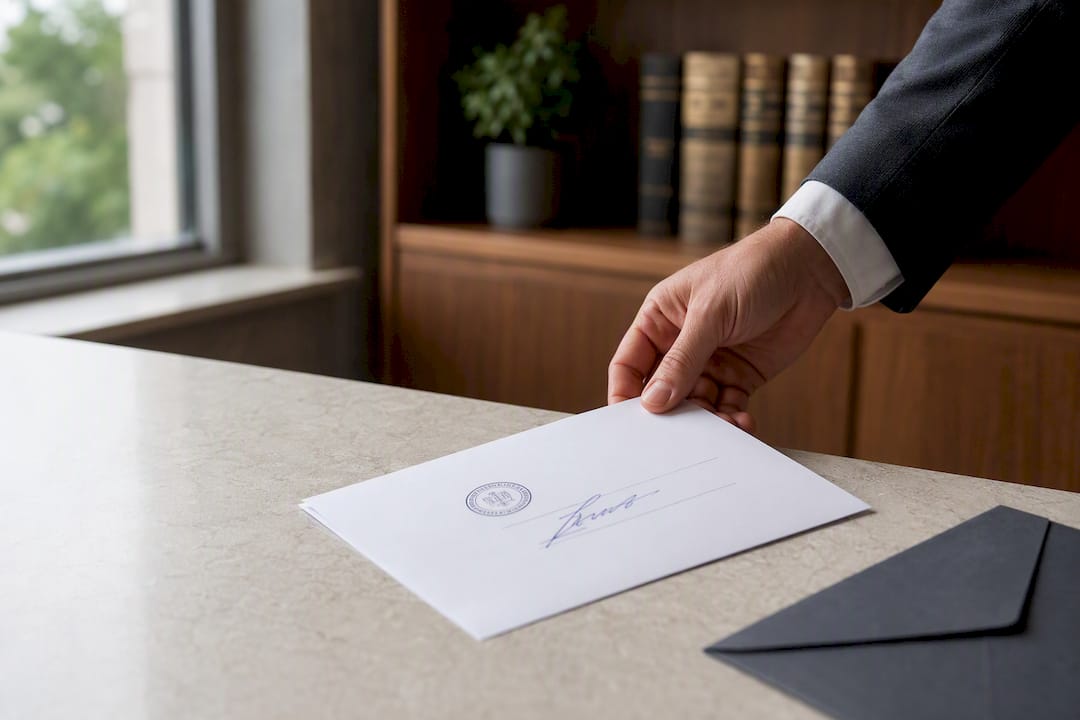
Online Notarization Apostille Canada: What Actually Works ! Wet-ink notarized document with signature and stamp Canada issues apostilles, but online notarization alone will not get you one.
Online Notarization Apostille Canada: What Actually Works
Canada issues apostilles, but online notarization alone will not get you one. Remote Online Notarization (RON) is legal for many domestic transactions, yet the government apostille process still requires a physical, wet-ink notarized document. Here is what to do right now.
- Check whether Global Affairs Canada (GAC) or a provincial authority handles your document type.
- Get a wet-ink notarization or a certified true copy if your only version is digital.
- Submit through the correct official portal, not a general online notary service.
Expect a per-document fee, a mailing step, and a processing window measured in business days, not minutes.
Key Takeaways
Getting an apostille in Canada requires a physical wet-ink notarized document, submitted to the correct federal or provincial authority, since online notarization alone does not satisfy current apostille requirements.
| Point | Details |
|---|---|
| RON alone is not enough | Government apostille issuance requires an original wet-ink signature, not a digital notarization. |
| Routing matters | GAC handles federal documents; Ontario, Alberta, BC, and Saskatchewan run their own provincial apostille services. |
| Fees and timing vary by authority | Alberta charges $25 per document with 7 to 10 business days processing; other provinces set their own schedules. |
| Digital-only documents need a workaround | A Notary can compare a printout to the digital original and issue a wet-ink certified true copy for apostille. |
| Speedy Apostille Services offers a managed option | Handles document review, notarization coordination, and submission with all-inclusive pricing and 1 to 7 day turnaround. |
Table of Contents
- Do You Actually Need an Apostille?
- Who Issues Apostilles: Global Affairs Canada or Your Province?
- Can You Use Online Notarization or an e-Apostille in Canada?
- How to Get an Apostille in Canada: Step by Step
- How Long Does It Take and What Does It Cost?
- How Do You Verify an Apostille Was Issued Correctly?
- Which Documents Get Apostilled, and Where People Get Rejected
- Let Speedy Apostille Services Handle the Paperwork for You
- Sources
- FAQ
Do You Actually Need an Apostille?
Not every document headed overseas needs one. You typically need an apostille or authentication for a marriage abroad, a foreign job offer, recognition of a Canadian degree by a foreign university or licensing body, incorporating a business overseas, or submitting court records to a foreign tribunal.
Some receiving countries and institutions skip the requirement entirely, especially for informal use. Before you spend money or mail an original document anywhere, confirm directly with the receiving authority, embassy, or consulate that an apostille is actually required for your case.
- Marriage, adoption, or family matters abroad
- Employment or immigration paperwork for a foreign employer
- Academic credential recognition
- Corporate registration or contracts overseas
- Court or legal proceedings outside Canada
When in doubt, the Government of Canada's authentication portal is the authoritative starting point for confirming what your document needs.
Who Issues Apostilles: Global Affairs Canada or Your Province?
Canada's accession to the Hague Apostille Convention means apostilles now come from more than one office, depending on where your document was issued or notarized. Send it to the wrong place and you lose days waiting for a redirect.
Global Affairs Canada handles federal documents and paperwork from provinces that have not set up their own competent authority. Provinces including Ontario (through Official Documents Services), Alberta, British Columbia, and Saskatchewan run their own apostille programs for documents issued or notarized within their borders.
- Federal documents (RCMP checks, federally incorporated business records) → Global Affairs Canada
- Ontario-issued or Ontario-notarized documents → Ontario's Official Documents Services
- Alberta-issued or Alberta-notarized documents → Alberta's competent authority
- BC or Saskatchewan documents → the respective provincial authority
The safest first move is the Government of Canada's authentication triage tool, which routes you to the right office before you spend a stamp.
Can You Use Online Notarization or an e-Apostille in Canada?
Short answer: not for a government-issued apostille, at least not yet. RON is legal for plenty of domestic Canadian transactions, but competent authorities require a physical document bearing an original wet-ink signature before they will attach an apostille. A digitally signed notarization, however valid it is for its original purpose, generally gets rejected at this stage.
The confusion often comes from the Hague Conference's own electronic Apostille Programme, or e-APP, which confirms that e-Apostilles are legitimate in principle. The catch: each country's competent authority decides whether to issue them. The Philippines already runs a functioning e-Apostille system with online delivery and QR verification. Canada's authorities currently issue physical apostilles only.
Pro Tip: If your only version of a document is digital, print it and bring it to a Notary Public, who can compare the printout against the original and issue a wet-ink Certified True Copy. That physical copy is what gets apostilled.
- RON: fine for many Canadian domestic uses, not for apostilles
- e-Apostille: valid where implemented, not yet standard in Canada
- Workaround: notarized wet-ink certified true copy of the digital original
How to Get an Apostille in Canada: Step by Step
Getting from a plain document to an apostilled one follows the same basic sequence no matter which authority handles it.
- Confirm the destination's requirement and identify whether GAC or a provincial office handles your document.
- Get the required notarization. If you only have a digital file, arrange a wet-ink certified true copy first.
- Complete the official submission form through the correct portal, attaching ID, a payment receipt, and return shipping details.
- Mail or courier the original documents to the correct address, following that authority's cover-sheet rules exactly.
- Track the request and respond quickly if the authority flags a correction; request a trackable return method.
- Or hand the whole thing to a service like Speedy Apostille Services if you would rather not manage the mailing and follow-up yourself.
A few things trip people up at each stage:
- Skipping the destination check and apostilling the wrong document type
- Sending a digitally signed notarization instead of a wet-ink one
- Forgetting the payment receipt or ID copy required by the portal
- Using standard mail with no tracking for an original government document
Global Affairs Canada's own submission page walks through the exact fields and attachments its form expects.
How Long Does It Take and What Does It Cost?
Processing time and fees depend entirely on which authority handles your document.
- Alberta's apostille service charges $25 per document with processing typically running 7–10 business days.
- Ontario, BC, and Saskatchewan post their own fee schedules and timelines on their respective competent-authority pages, and these change, so check before you submit.
- A privately managed service handling submission on your behalf often quotes 1–3 business days once your paperwork is in order, since the delay is usually mailing and internal queue time, not the stamp itself.
Pro Tip: Use tracked shipping both ways, prepay the return courier if the authority allows it, and keep your online payment receipt. Alberta specifically asks applicants to mail proof of payment with the documents.
Rush fees exist at some authorities and through most private services, but they add cost on top of the base fee, not instead of it.
How Do You Verify an Apostille Was Issued Correctly?
Most Canadian competent authorities let you or a receiving party confirm an apostille through an online lookup, contact request, or verification note on the authentication page tied to the issuing office. Some jurisdictions abroad, like the Philippines, use QR codes and serial-number databases; Canadian authorities generally verify by direct inquiry to the issuing office.
Verification fails most often because of a name mismatch between the document and supporting ID, a missing or damaged seal, or submission to the wrong authority in the first place.
- Double-check spelling and name order against the original ID before submitting
- Confirm you sent the document to the authority actually responsible for it
- Contact the issuing authority directly if a foreign recipient questions authenticity
- Request re-issuance rather than trying to self-correct a flawed apostille
Which Documents Get Apostilled, and Where People Get Rejected
Birth, marriage, and death certificates, diplomas and transcripts, notarized powers of attorney, corporate records, and RCMP criminal record checks make up most apostille requests. RCMP checks route through Global Affairs Canada specifically, not the provinces.
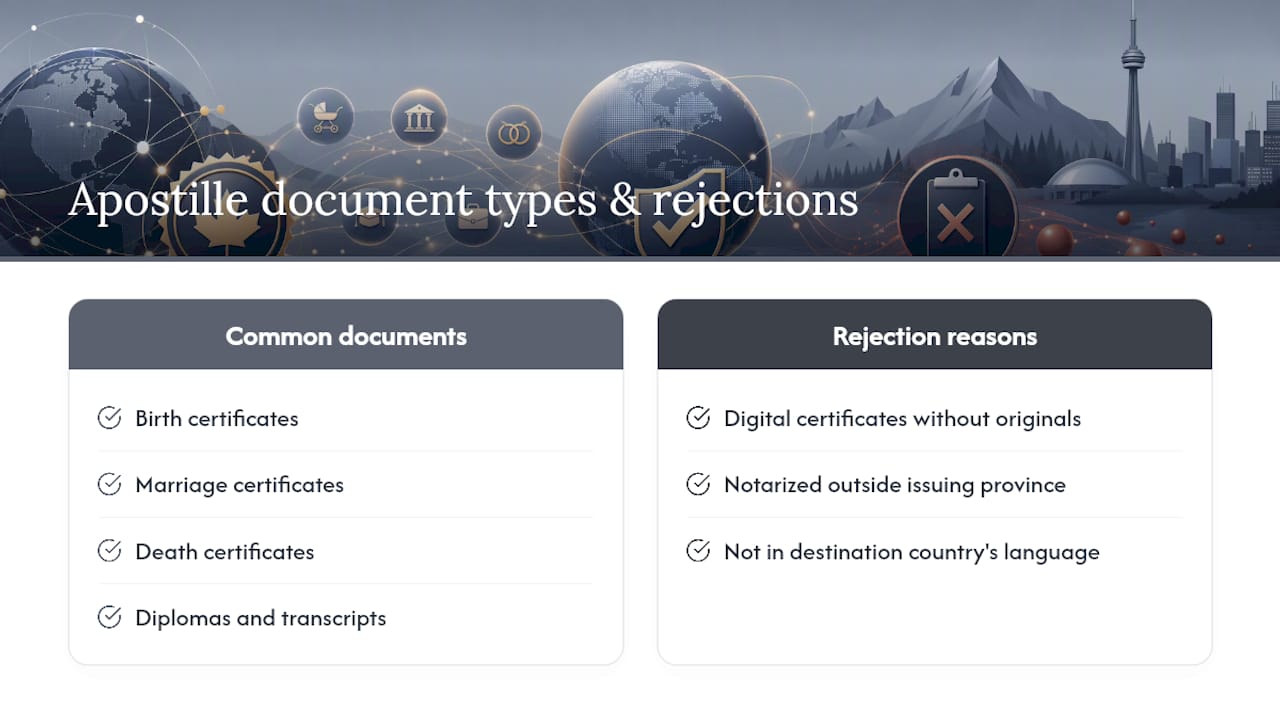
A few situations need an extra step before they qualify. Documents notarized outside the province that issued them, digitally issued certificates with no physical original, and anything not already in the destination country's language often need a certified true copy, additional notarization, or a certified translation first.
A detailed guide on apostilling a birth certificate covers the vital-records path in more depth if that's your situation.
A Practical Note on Where People Get Stuck
Most delays trace back to one mismatch: people have a digital document and assume a digital signature will satisfy a process built around physical paper. When in doubt, get the wet-ink certified true copy before you submit anything. It's the one step that prevents almost every rejection this process produces.
Let Speedy Apostille Services Handle the Paperwork for You
If the routing, mailing, and follow-up above sound like more than you want to manage yourself, that's exactly the gap Speedy Apostille Services fills. Based in Toronto, the service reviews your documents, coordinates the required notarization, submits to the correct competent authority, and returns your apostilled paperwork by tracked courier, with government fees built into one all-inclusive price instead of surprise add-ons later.

Turnaround typically runs 1 to 7 days depending on document type and service tier, faster than most people manage handling it solo through the mail. The government process remains the same either way; hiring help is optional, not a requirement, and useful mainly for readers who want one point of contact instead of tracking a submission themselves. Toronto and GTA clients can also arrange in-person drop-off through the Etobicoke or Mississauga service locations. Check document requirements and get a quote on the Speedy Apostille Services site to see current turnaround for your document type.
Sources
Fees, forms, and processing steps change without much notice, so confirm details directly on these pages before you submit anything.
- Documents for other jurisdictions or countries
- Authentication of documents
- e-Apostille (Philippine DFA)
This article is general information, not a substitute for advice from a qualified lawyer. Consult a qualified legal professional about your own circumstances before acting on anything here.
FAQ
How Do I Get an Apostille From Canada?
Confirm which authority handles your document (Global Affairs Canada or your province), get it notarized with a wet-ink signature if needed, then submit through the official portal with ID and payment proof.
Does Canada Accept Online Notary for Apostilles?
No. Canadian competent authorities require a physical, wet-ink notarized document; a purely digital notarization is generally rejected as the basis for an apostille.
How Long Does It Take to Get an Apostille in Canada?
It depends on the authority. Alberta lists 7 to 10 business days, while a managed service like Speedy Apostille Services often completes handled submissions in 1 to 7 days.
Can I Get Online Notarization in Canada?
Yes, RON is legal for many domestic Canadian transactions, but it does not currently satisfy the wet-ink requirement for a government-issued apostille.