
Apostille vs Legalization Canada: Which One Do You Need?
Apostille vs Legalization Canada: Which One Do You Need? !

Apostille vs Legalization Canada: Which One Do You Need?
If your destination country belongs to the Hague Apostille Convention, you need an apostille. If it doesn't, you need authentication and consular legalization instead.
- Apostille: one certificate, issued by a Canadian competent authority, accepted directly by any of the more than 120 member countries.
- Legalization: authentication by a Canadian authority, followed by a separate stamp from the destination country's embassy or consulate.
Global Affairs Canada, provincial offices in Alberta, British Columbia, and Saskatchewan, and ServiceOntario are the authorities that actually issue these documents. Everything below explains how to pick the right path and complete it.
Key Takeaways
Whether you need an apostille or full legalization depends entirely on one fact: whether your destination country belongs to the Hague Apostille Convention.
| Point | Details |
|---|---|
| Check membership first | Confirm the destination country's Hague Convention status before choosing a process. |
| Match the issuing authority | Send Ontario, Alberta, British Columbia, and Saskatchewan documents to their own provincial office; everything else goes to Global Affairs Canada. |
| Foreign documents can't be apostilled here | A document issued outside Canada must be authenticated in its country of origin, not in Canada. |
| Legalization still applies for non-members | Non-Convention destinations require authentication plus a separate embassy or consulate legalization step. |
| Speedyapostilleservices handles the routing | Speedyapostilleservices offers all-in pricing with government fees included and typical 2 to 3 day turnaround for Canadian apostille requests. |
Table of Contents
- Apostille vs Legalization Canada: What Each Term Actually Means
- Is the Destination Country a Hague Convention Member?
- How Do You Decide Between Apostille and Legalization?
- How Do You Get an Apostille on a Canadian Document?
- How Do You Legalize Documents for Non-Convention Countries?
- How Do You Verify an Apostille and Avoid Common Mistakes?
- Skip the Runaround With Speedy Apostille Services
- Sources
- FAQ
Apostille vs Legalization Canada: What Each Term Actually Means
An apostille is a single, standardized certificate. A designated Canadian authority attaches it to your document, usually as a physical page called an "allonge," and every country in the Apostille Convention has to accept it without further steps.
Legalization is older and clunkier. It's a two-part chain: a Canadian authority authenticates the document first, then the destination country's embassy or consulate in Canada adds its own legalization stamp on top. This is the process Canada used for every country before joining the Convention, and it's still the only option for non-member destinations.
Not every document qualifies for either process. Eligible categories include birth and marriage certificates, education records, corporate and export documents, and notarized documents. An apostille or authentication confirms that a signature or seal is genuine; it does not verify that the contents of the document are true.
- Birth certificate, marriage certificate, or death certificate
- Diploma, transcript, or professional license
- Court order or corporate resolution
Is the Destination Country a Hague Convention Member?
Confirm this before you do anything else, because it determines which office you contact and what you pay.
- Ask the receiving institution or foreign employer exactly what they require.
- Check the official list of Hague Convention member countries.
- Confirm whether the recipient also wants a certified translation, since some do even when an apostille is enough.
Pro Tip: Get the requirement confirmed in writing from the foreign recipient or embassy before you pay for anything. Refunds on government processing fees are rare, and the wrong certificate means starting over.
Global Affairs Canada and provincial government pages keep these lists current, so check them close to your submission date rather than relying on older guidance.
How Do You Decide Between Apostille and Legalization?
Three questions settle almost every case.
- Is the destination country a Hague Convention member? If yes, you need an apostille. If no, you need legalization.
- Was the document issued or notarized in Canada? Only Canadian-issued or Canadian-notarized documents can receive a Canadian apostille.
- Does the recipient want anything beyond the base certificate? Some ask for certified translations or extra copies.
A few real-world outcomes:
- A university in France asks for your Ontario diploma: apostille, since France is a Convention member.
- An embassy in a non-Convention country asks for your birth certificate: full legalization chain required.
- You have a document issued in another country: it can't be apostilled in Canada at all. It has to go back to its country of origin for authentication, because Canada only apostilles documents it issued or notarized itself.
Legal commentary has flagged a real pattern here: many Canadians assume an apostille is automatically required, when the receiving authority sometimes doesn't need any authentication at all. Ask first. Pay second.
How Do You Get an Apostille on a Canadian Document?
Who issues your apostille depends entirely on where the document came from. Ontario documents go through ServiceOntario's Official Documents Services. Alberta, British Columbia, and Saskatchewan each run their own provincial authentication offices. Documents from every other province, territory, or federal source go to Global Affairs Canada.
The process itself follows a consistent sequence:
- Confirm the document is eligible (issued or notarized in Canada, and a category the Convention covers).
- Get it notarized first if it's a private document, such as a signed affidavit or a copy of a passport.
- Send it to the competent authority that matches its province of origin.
- Receive the document back with the apostille attached as an allonge.
Processing times vary by office and season, and fees are published by each issuing authority rather than fixed nationally, so check the current provincial processing timelines before you plan around a deadline.
The switch to a single apostille cut out an entire embassy step for Hague-member destinations, which is the single biggest change Canadians dealing with international paperwork have seen in this process in years.

Pro Tip: The most common delay isn't paperwork errors. It's sending an Ontario-issued document to Global Affairs Canada, or a federal document to a provincial office. Match the issuing jurisdiction to the correct authority before you mail anything.
How Do You Legalize Documents for Non-Convention Countries?
For destinations outside the Apostille Convention, the traditional chain still applies, and it has more steps than an apostille.
- Notarize the document if it's a private document requiring a signature witness.
- Get provincial authentication, if your province offers this step for the document type.
- Get federal authentication through Global Affairs Canada.
- Bring the authenticated document to the destination country's embassy or consulate in Canada for legalization.
Each step verifies something different: notarization confirms a signature, authentication confirms the notary's or official's credentials, and consular legalization confirms the document is acceptable to that specific country.
Embassies vary widely in how they handle this. Some require appointments booked weeks out. Some refuse documents brought by anyone other than the applicant. Some add their own fees on top of Canadian government fees. Contact details and consular rules are listed on the Global Affairs consular and diplomatic pages, and it's worth calling ahead rather than assuming a general rule applies.
- Confirm the embassy's hours and hand-in policy before traveling there
- Bring original documents plus copies, since some consulates keep one
How Do You Verify an Apostille and Avoid Common Mistakes?
Once you receive an apostille, check it before you send it anywhere. Global Affairs Canada publishes a verification index for apostilles it issues, and participating provinces maintain their own. Keep the apostille number and issuance date on hand. That's what the recipient or verifier will ask for.
Most rejected or delayed documents fail for a handful of predictable reasons:
- Sent to the wrong office (provincial instead of federal, or the wrong province entirely)
- Attempted apostille on a foreign-issued document Canada has no authority over
- Missing notarization on a private document that required it
- Wrong document type submitted for the intended use
Pro Tip: Track your document through the mail with a signature-required service, and keep a scanned copy before you send the original anywhere. Lost apostilled documents are hard and slow to replace.
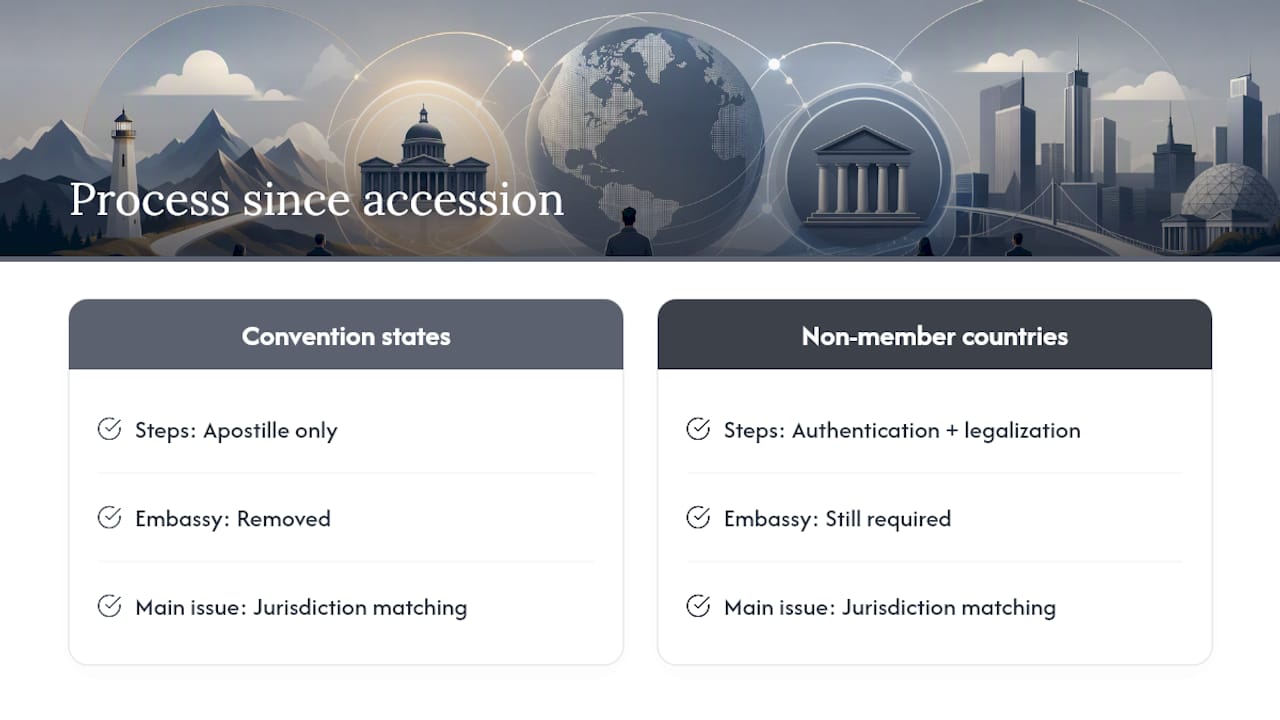
How the process changed since Canada joined the convention
Since accession, apostilles cut the embassy step entirely for Convention destinations, but non-member countries still require the full authentication and legalization chain. Handling this volume of Canadian apostille requests since 2023 has made one thing clear: jurisdiction matching, not paperwork complexity, is what actually trips people up.
Skip the Runaround With Speedy Apostille Services
You can absolutely handle either process yourself using the steps above. But between notarization, matching the right provincial office, and tracking down embassy hours, it adds up to a lot of unpaid administrative time for a document you probably need fast.

Speedyapostilleservices reviews your document, handles notarization when it's needed, submits it to the correct issuing authority, and returns it to you securely, typically within 2 to 3 days. Pricing is all-in: government fees are bundled into the quote upfront, so there's no surprise charge after submission. Same-day service is available for Toronto and GTA clients who can't wait out standard turnaround. Check your document against the document checklist and get an instant quote to start.
Sources
FAQ
Can I get an apostille on Canadian documents?
Yes, if the document was issued or notarized in Canada and falls into an eligible category such as a birth certificate, diploma, or corporate record. Foreign-issued documents cannot receive a Canadian apostille.
Is an apostille required for Canada?
An apostille is required only when your destination country is a Hague Convention member and the receiving institution asks for one. Always confirm with the recipient first, since some accept documents without any authentication.
How long does it take to get an apostille in Canada?
Processing times vary by issuing office and season, so check current timelines directly with your provincial authority or Global Affairs Canada. Services like Speedyapostilleservices typically complete the process in 2 to 3 days.
Does ServiceOntario do apostilles?
Yes, ServiceOntario's Official Documents Services issues apostilles for documents issued or notarized in Ontario, and it publishes eligibility rules and fees for the process.
What's the difference between apostille and notarization?
Notarization confirms a signature is genuine and often happens before authentication. An apostille or authentication confirms that the notary's own credentials and seal are legitimate, one step further up the chain.