
Avoid Rejection and Extra Costs: Apostille Fees by Province in Canada
Avoid Rejection and Extra Costs: Apostille Fees by Province in Canada ! Envelopes sorted between authentication authorities Whether a government apostille fee applies depends on which competent authority issues your document: some Global Affairs Canada services carry no fee, while every province c
Avoid Rejection and Extra Costs: Apostille Fees by Province in Canada
Whether a government apostille fee applies depends on which competent authority issues your document: some Global Affairs Canada services carry no fee, while every province charges a set per-document rate. Before you send anything, find the office where the document was originally issued and check its official page for the current fee. Speedy Apostille Services, a Toronto-based provider, offers a managed alternative that bundles the government fee into one price, but checking the issuing authority yourself remains the first step either way.
TL;DR:
- Federal apostille fees through Global Affairs Canada are generally free, but provincial offices charge between $16 and $25 per document, with some provinces offering flat rates.
- Incorrectly submitting documents to the wrong authority, especially mixing federal and provincial offices, causes delays and increases costs due to processing rejections.
- Processing times range from 7 to 15 business days plus additional mail transit time, leading to a total of one month or more for urgent needs.
- Courier, notarization, and translation costs often surpass the government fee, with notarization sometimes exceeding $25 per document and postage adding further expenses.
- Managed apostille services bundle fees, including government costs and rapid turnaround options, ideal for urgent deadlines or multiple documents across jurisdictions.
Table of Contents
- Why Government Apostille Fees Differ Across Canada
- What Do Government Apostille Fees Cost by Province?
- How Do You Find the Right Competent Authority?
- How Long Does Apostille Processing Actually Take?
- What Costs More Than the Government Fee?
- How Do You Pay and Protect Your Return Documents?
- Pre-Submit Checklist: Avoid Delays and Rejections
- Publisher Perspective: What a Managed Apostille Service Actually Solves
- Ready to Order? What to Prepare Before You Submit
- Sources
- FAQ
Why Government Apostille Fees Differ Across Canada
Canada has no single national fee schedule because two separate systems issue apostilles. Global Affairs Canada authenticates federal documents and RCMP records, while each province runs its own authentication program for provincially issued paperwork like birth certificates, marriage licenses, and notarized documents.
That split explains why fee pages look so different depending on where you land. Some Ottawa Authentication Services charge no fee at all for certain document types, while provinces like Ontario and British Columbia publish clear per-document rates. A document issued by a hospital in Alberta goes to Alberta's authentication office, not to Ottawa. Mixing up the two is one of the most common reasons submissions bounce back unprocessed.
What Do Government Apostille Fees Cost by Province?
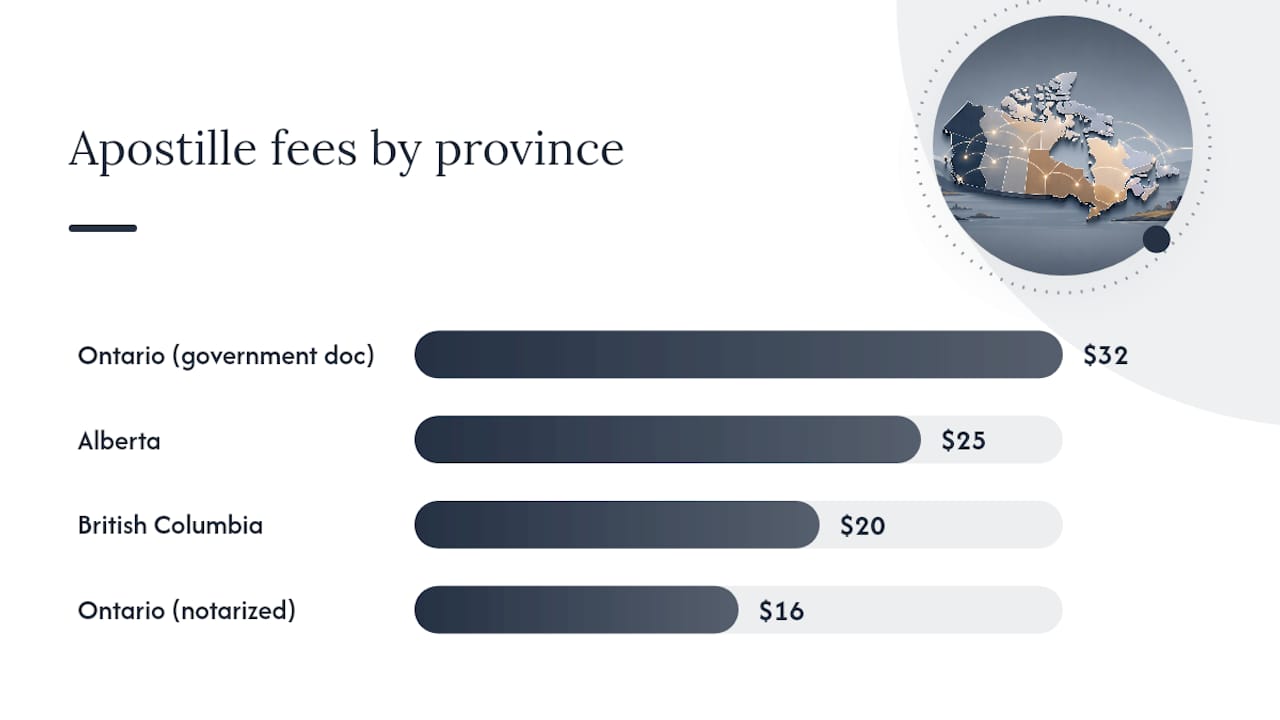
Fees are charged per document, not per application, so a stack of five records at $20 each adds up fast. Categories matter too: a notarized personal document and an official government-issued record often carry different rates within the same province.
| Issuing Authority | Fee per Document | Notes |
|---|---|---|
| Global Affairs Canada (Ottawa) | No fee for some services | Applies to select federal authentication requests |
| British Columbia | $20 | Flat rate regardless of document type |
| Ontario | $16 (notarized legal document) / $32 (Ontario government document) | Two tiers depending on document category |
| Alberta | $25 | One payment per submission, cash not accepted |
Ontario's two-tier structure trips up a lot of applicants. A notarized power of attorney and a government-issued transcript sound similar, but the Ontario Official Documents Services office treats them as different categories with different fees. British Columbia keeps it simple with one flat $20 rate no matter what you're authenticating, and Alberta follows a similar single-rate model at $25.
These numbers change. Provincial offices update fee schedules without much notice, so confirm the current rate on the issuing authority's own page before you mail anything or write a check.
How Do You Find the Right Competent Authority?
Sending a document to the wrong office is the fastest way to lose two weeks. Work through this before you submit anything:
- Identify where the document was physically issued. A birth certificate from Manitoba goes to Manitoba's authentication office, not Ontario's, even if you now live in Toronto.
- Match the document type to its typical handler. Vital records and provincial court documents usually route through the issuing province; federal documents, RCMP background checks, and some corporate records go to Global Affairs Canada.
- Postsecondary transcripts often need provincial authentication first, since universities are provincially regulated institutions.
- When a document touches more than one jurisdiction, such as a corporate record notarized in one province but registered in another, check both offices before sending.
Send it to the wrong desk and you'll typically get it returned unprocessed rather than forwarded, costing you the mail time twice over.
How Long Does Apostille Processing Actually Take?
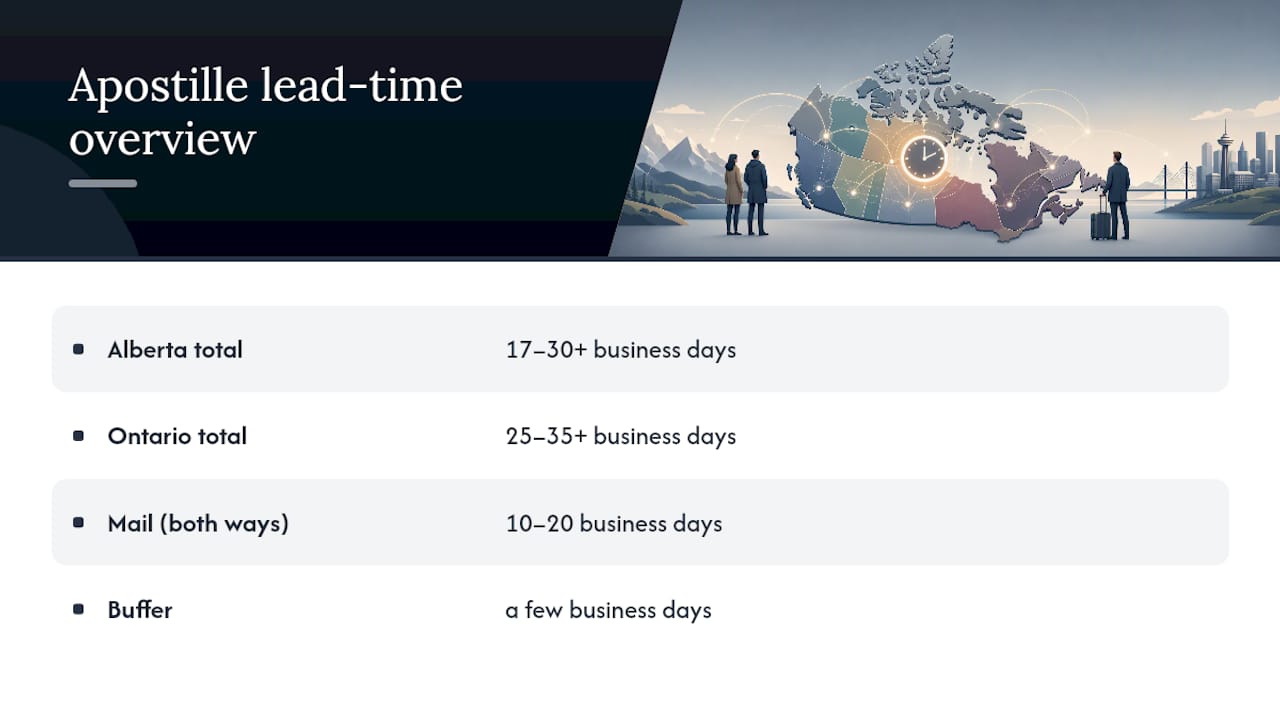
Processing windows vary widely by authority, and none of them include the time your envelope spends in transit. Alberta lists a processing window of 7 to 10 business days, while Ontario's ODS office states up to 15 business days for standard requests.
That figure is only half the equation. Mail or courier transit typically runs 5 to 10 additional business days each way, since offices process what's on their desk and don't count delivery time. A workable formula: total lead time equals processing days, plus mail time there and back, plus a buffer of a few extra days for anything unexpected. For Ontario's 15-day window, that can realistically stretch past a month once you factor in mail both ways.
What Costs More Than the Government Fee?
The government fee is usually the smallest line item on the bill. Notarization, translation, and courier costs routinely add up to more than the apostille fee itself.
- Notary or lawyer fees for signing and sealing a document before authentication
- Certified translation, often required if the destination country doesn't use English or French
- Courier fees for expedited delivery to and from the authentication office
- Return shipping upgrades if you want tracked delivery instead of standard mail
Pre-notarization is the one people underestimate most. A notary visit can run higher than the $20 to $25 government fee itself, especially if a lawyer's office charges by the signature.
Pro Tip: If you have multiple documents from the same province, submit them together in one package. You'll pay one courier fee instead of several, even though each document still carries its own government fee.
How Do You Pay and Protect Your Return Documents?
Payment methods differ by office. Some provinces accept credit cards and money orders; others require a bank draft. None of them accept cash for mailed submissions, based on Alberta's guidance.
- Confirm accepted payment types on the specific authority's page before mailing your check or draft
- Include a prepaid courier waybill or tracked, self-addressed envelope, since regular mail return carries no tracking
- Keep a copy of your payment receipt and any submission confirmation for follow-up if something goes missing
Pre-Submit Checklist: Avoid Delays and Rejections
Most rejected submissions fail for the same avoidable reasons. Work through these steps before anything leaves your hands:
- Confirm the correct issuing authority and its current fee, since rates change without much notice.
- Verify the document has an original signature and seal that the authority recognizes; missing seals and incorrect notary stamps are common rejection triggers.
- Include payment in an accepted form and a tracked return option in the same package.
- Photocopy everything and log the mailing date before you send it.
Pro Tip: Use a tracked courier service both ways, and if the destination requires a spare certified copy, include one now rather than restarting the whole process later.
For a single document with no deadline pressure, doing this yourself is straightforward. For urgent deadlines, multiple documents across different provinces, or unfamiliar jurisdictions, a managed service removes the guesswork of matching document types to authorities.
Publisher Perspective: What a Managed Apostille Service Actually Solves
The government fee itself is rarely the problem. Confusion over which authority to use, and the mail time nobody budgets for, is what actually derails most self-managed submissions.
Certain managed apostille services bundle the government fee into a single all-in price rather than billing it as a separate line item after the fact. Some providers state a typical turnaround of 2 to 3 days, backed by document review before submission and secure handling throughout. That kind of speed matters most in three situations: a visa or job deadline that can't slip, multiple documents originating from different provinces, or a document type you've never authenticated before and don't want to risk getting wrong on the first try.
These are publisher-provided service claims. Full details on pricing tiers and document types sit on the Speedy Apostille Services landing page, and readers doing a single straightforward document with no time pressure may find the DIY route perfectly workable.
— Ken
Ready to Order? What to Prepare Before You Submit
A managed service may offer an alternative to hunting down the right provincial office yourself: one all-in price that already includes the government fee, so there's no separate charge waiting for you later in the process.

Before placing an order, gather your original paper document (copies and digital scans generally can't be used), a piece of government-issued ID, your current contact information, and the address where you want the authenticated document returned. Turnaround tiers may range based on how quickly you need the document back, and steps from document review to secure return handling can be built into the quoted price rather than added afterward. If you're weighing whether to handle this yourself or hand it off, the Speedy Apostille Services page walks through exactly what's included and lets you start an order directly.
Sources
FAQ
How Can I Apostille a Document in Canada?
Identify the competent authority based on where your document was issued, whether that's Global Affairs Canada or a provincial office, then submit the original paper document with payment and a tracked return option. Providers like Speedy Apostille Services also offer a managed submission service that handles this process for you.
How Long Does an Apostille Take in Canada?
Government processing alone runs about 7 to 10 business days in Alberta and up to 15 business days in Ontario, not counting mail transit. Add 5 to 10 business days each way for shipping to get a realistic total.
Does ServiceOntario Handle Apostilles?
Ontario authentication requests go through the Ministry's Official Documents Services (ODS) office rather than a standard ServiceOntario counter, and fees run $16 to $32 per document depending on the category. Check the Ontario government page directly, since submission channels can differ from other provincial government services you may have used before.